What Robotic Milking Actually Does
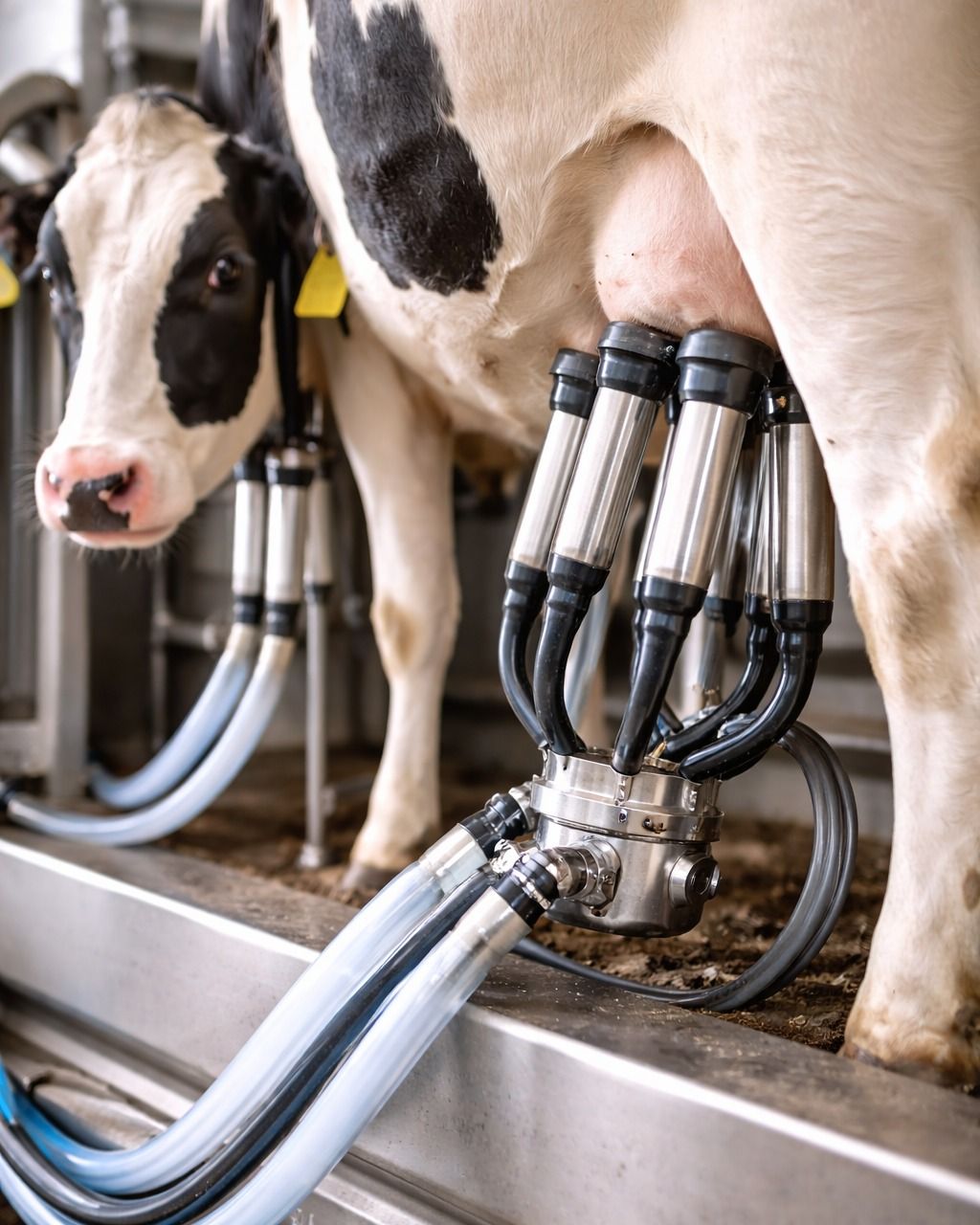
Modern automated milking systems, produced by global leaders including the Netherlands' Lely, Sweden's DeLaval, Germany's GEA Group, and Israel's Afimilk, use robotic arms, laser-guided teat detection, and AI-driven analytics to milk cows with minimal human intervention while continuously monitoring each animal's milk output, health indicators, and behaviour patterns. Farmer's Weekly, South Africa's leading agricultural publication, has begun actively covering the welfare case for the technology, highlighting how automated systems allow cows to be milked on their own schedule rather than a fixed herd-wide timetable — a shift that reduces physical stress on cattle and has been shown to improve overall herd comfort and milk yield consistency.
The economics behind the technology have matured considerably. Installed capital cost per robotic unit now typically ranges from $150,000 to $220,000 across the major manufacturers, with each robot generally rated to handle between 55 and 70 cows, though independent analysis suggests the genuine profit sweet spot sits closer to 60 cows per robot for high-producing herds. Globally, robotic milking systems now represent a market worth more than $5.7 billion, with fully automated units accounting for over 62 percent of that total — evidence the technology has moved well past its experimental phase into mainstream commercial dairy operations across Europe, where roughly 48 percent of dairy farms have already adopted some form of milking automation.
Why Africa Has Lagged — And Why That's Starting to Shift
The Middle East and Africa milking automation market remains comparatively small, valued at approximately $71.3 million in 2024 and projected to reach $82.4 million by 2031 — modest figures next to Europe's dominant share of the global market, reflecting both the higher upfront capital costs involved and the smaller average herd sizes across most African dairy operations, which historically have made the return-on-investment case harder to justify than on Europe's large, labour-constrained commercial farms.
Sponsored
That calculus is beginning to shift for a specific segment of the market: larger, more capital-intensive commercial dairy operations, particularly in South Africa, where labour costs and availability are increasingly pushing farm owners to evaluate automation more seriously. Industry analysts note that commercial dairy farms currently dominate the broader Middle East and Africa automation market, and that the integration of artificial intelligence into automated milking systems is fundamentally changing how the technology is being marketed and adopted — with AI-powered camera systems for health monitoring and early disease detection increasingly framed as being just as valuable to a farm's bottom line as the milking automation itself.
The Realistic Path for African Dairy Farms
Global dairy technology analysts note that the decision to adopt robotic milking increasingly depends heavily on herd size and farm structure rather than a simple yes-or-no technology question. For smaller herds, quality-of-life considerations for the farm owner often drive the decision as much as pure economics; for herds in the 200-to-300-cow range, robotic and automated feeding systems tend to hit their clearest economic sweet spot; and for very large operations exceeding 1,000 cows, high-efficiency conventional milking parlours can still outperform robots on cost at current labour rates in some markets — a nuance South African commercial dairies will need to weigh carefully given the country's comparatively lower labour costs relative to Europe, where automation economics are more straightforwardly favourable.
Where the case is clearest is welfare and data. Beyond labour savings, automated systems generate granular, cow-level data on milk yield, feed intake, and behaviour patterns that allow farmers to manage individual animals rather than relying on herd-wide averages — a shift dairy technology analysts describe as farming's move from managing herds to managing cows as individual production and health units. For South African dairy operations competing increasingly on both efficiency and animal welfare credentials in export and premium domestic markets, that data-driven precision may ultimately prove as valuable as the labour savings that first drew global dairy farms to robotic milking three decades ago.
As global manufacturers continue refining their offerings — DeLaval's Flow-Responsive Milking technology, launched to reduce milking time by up to 10 percent, and Lely's newest A5 Next platform, which showed a 10 percent increase in milkings between service alerts during field trials — the technology arriving on South African farms today is considerably more mature and cost-efficient than the systems first piloted in Europe decades ago, giving the continent's earliest adopters a meaningfully lower-risk entry point than pioneering dairies faced in the 1990s.