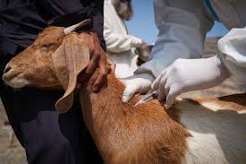
Senegal has launched an ambitious livestock vaccination campaign for 2026–2027, targeting eight million sheep and goats as authorities step up efforts to protect animal health and strengthen livestock productivity.
The campaign was officially launched on 24 October in Ndiaganiao, in the Mbour department of western Senegal. Livestock Minister Ousmane Diagne announced the targets, which also include 3.1 million cattle, 300,000 equines and two million rural poultry birds.
The programme focuses on major livestock diseases, including peste des petits ruminants (PPR), contagious bovine pleuropneumonia, lumpy skin disease, African horse sickness and Newcastle disease.
Why sheep and goats are a priority
Sheep and goats are important sources of income, food and financial security for many Senegalese households. They support meat production and local trading, while animals can also serve as assets that families sell when money is needed.
Peste des petits ruminants is particularly serious for small ruminants. The contagious viral disease can cause fever, mouth lesions, respiratory problems, diarrhoea and high mortality, especially in susceptible herds. Vaccination, supported by good husbandry and veterinary oversight, is an important tool for prevention.
The government’s targets build on the previous campaign. Minister Diagne reported that nearly seven million small ruminants and more than 2.7 million cattle had been vaccinated during the 2025–2026 campaign. The new targets represent an effort to expand protection further.
Sponsored
Reaching farmers will determine the outcome The minister stressed that achieving the targets will require cooperation between veterinary services, local authorities, private veterinarians, livestock organisations and farmers.
He also highlighted the need for adequate vaccination equipment, infrastructure and a reliable cold chain to ensure vaccines are stored and transported correctly.
For livestock keepers, the campaign is a reminder to contact local veterinary services about vaccination schedules, animal eligibility and any required documentation. Farmers should not assume that every disease can be controlled through the same vaccine or schedule.
What this means for livestock businesses
Reducing preventable disease can help protect breeding animals, limit mortality and support more predictable livestock production. Better animal health also benefits traders and meat businesses that depend on reliable supplies.
The campaign’s success will depend not only on the number of animals vaccinated but also on coverage, correct vaccine handling, disease surveillance and follow-up.
Senegal’s 2026–2027 campaign therefore represents a significant investment in livestock protection, with sheep and goat farmers among its central beneficiaries.