Most fertilizer problems are not actually fertilizer problems Across many farming systems in Zambia, fertilizer is treated as the central answer to low yields. When crops perform poorly, the immediate assumption is usually: not enough fertilizer wrong fertilizer brand delayed supply rising input costs But in many fields, the real problem is not whether fertilizer was applied. It is whether the crop was capable of using it efficiently in the first place. This is the uncomfortable reality behind many disappointing harvests: fertilizer does not automatically create yield. Timing, placement, soil conditions, and crop stage determine whether nutrients are converted into production—or lost.
Plants do not use nutrients equally throughout the season One of the biggest misunderstandings in crop production is assuming fertilizer works like fuel poured into a machine. Crops do not absorb nutrients at a constant rate. Different nutrients become critical at different stages: early root establishment vegetative growth flowering grain formation This means fertilizer timing is not a logistical detail. It is part of yield formation itself. A correctly timed application can outperform a larger but poorly timed one.
Fertilizer types exist because crops need different functions Fertilizers are often discussed by brand names, but the more important issue is nutrient function. Different fertilizer types serve different physiological roles inside the crop.
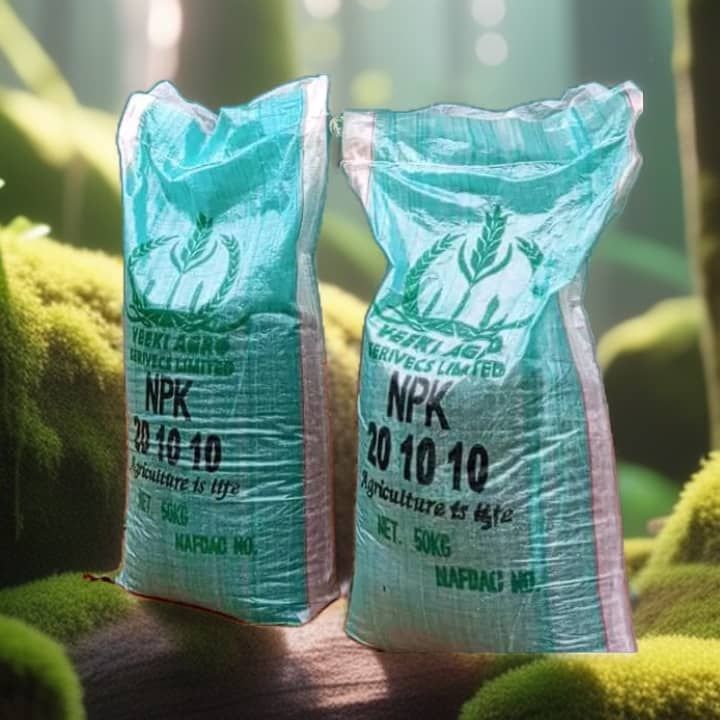
Basal fertilizers build establishment Basal fertilizers such as Compound D are typically rich in: phosphorus moderate nitrogen potassium These nutrients are critical during early growth because they support: root development early vigor energy transfer inside the plant This is why basal fertilizer is most effective at planting, when the crop is establishing its structural foundation. Applying basal fertilizer too late weakens its purpose because the crop has already passed its most sensitive establishment phase.
Top dressing fertilizers drive vegetative expansion Top dressing fertilizers such as Urea mainly supply nitrogen. Nitrogen supports: leaf formation chlorophyll production vegetative growth canopy expansion This stage is where the crop builds its photosynthetic engine. But nitrogen response depends heavily on timing. Applied too early: nutrients may leach before peak demand Applied too late: the crop may become greener without significantly improving grain yield This is one of the most common mistakes in maize production: confusing visual greenness with actual productivity.
Timing determines fertilizer efficiency more than quantity alone Many farmers focus on fertilizer rates while underestimating timing windows.
In reality, nutrient efficiency declines sharply when applications miss the crop’s biological demand stages. A crop that experiences nutrient stress early may never fully recover its yield potential, even if fertilizer is added later. This is because early nutrient shortages affect: root expansion plant uniformity leaf area development cob formation potential By mid-season, the crop is often managing limitations already created weeks earlier.
Sponsored
Fertilizer placement matters more than many farmers realize Even the correct fertilizer can perform poorly when placement is wrong. Common mistakes include: direct seed contact causing burn damage surface application before heavy rainfall uneven spreading poor incorporation into soil Nutrients are highly sensitive to movement, moisture, and root access. Nitrogen, especially, is vulnerable to: volatilization runoff leaching This means fertilizer losses can occur before the crop absorbs meaningful amounts. In some cases, farmers are not feeding crops. They are feeding inefficiency.
Soil condition controls fertilizer response One of the most overlooked realities in agriculture is that fertilizer performance depends on soil condition. Compacted soils, acidic soils, and poorly drained fields reduce nutrient uptake efficiency regardless of application rate. This explains why some farmers increase fertilizer quantities every season without proportional yield gains.
The issue is often not nutrient supply alone. It is the soil’s ability to: retain nutrients support root activity maintain biological function Fertilizer works best in functioning systems—not degraded ones.
Why fertilizer recommendations often fail in practice Standard fertilizer recommendations are usually generalized. But fields are not uniform. Differences in: rainfall patterns soil texture organic matter drainage planting dates all affect nutrient behavior differently. This is why identical fertilizer programs can produce very different outcomes between farms—or even between sections of the same field. Agriculture is not only about input application. It is about input interaction with environment and timing.
The hidden cost of poor fertilizer timing Poor fertilizer timing creates losses that are often invisible during the season. The crop may still appear green. The field may still look “healthy.” But internally, the crop may already be operating below potential due to: uneven growth restricted root systems delayed canopy development weak grain filling By harvest, these hidden inefficiencies appear as: lower yields
smaller cobs poor grain weight reduced profitability At that point, the opportunity for correction is gone.
Fertilizer is most effective when the crop never experiences interruption High-performing cropping systems are usually not defined by extreme fertilizer use. They are defined by consistency. The crop establishes early. Nutrients become available when needed. Growth continues without major interruption. This creates: uniform plant development stronger canopy formation better sunlight capture more stable grain production Fertilizer performs best when supporting momentum, not repairing stress.
Conclusion: timing is part of the fertilizer itself In many farming systems, fertilizer is treated as a product decision. In reality, it is a timing system. The same fertilizer can behave very differently depending on: when it is applied where it is placed what condition the soil is in what stage the crop has reached This is why successful nutrient management is not just about buying fertilizer. It is about synchronizing nutrients with crop demand before the season begins to limit yield potential. Because once nutrient stress has already slowed the crop, later correction rarely restores what was lost early.