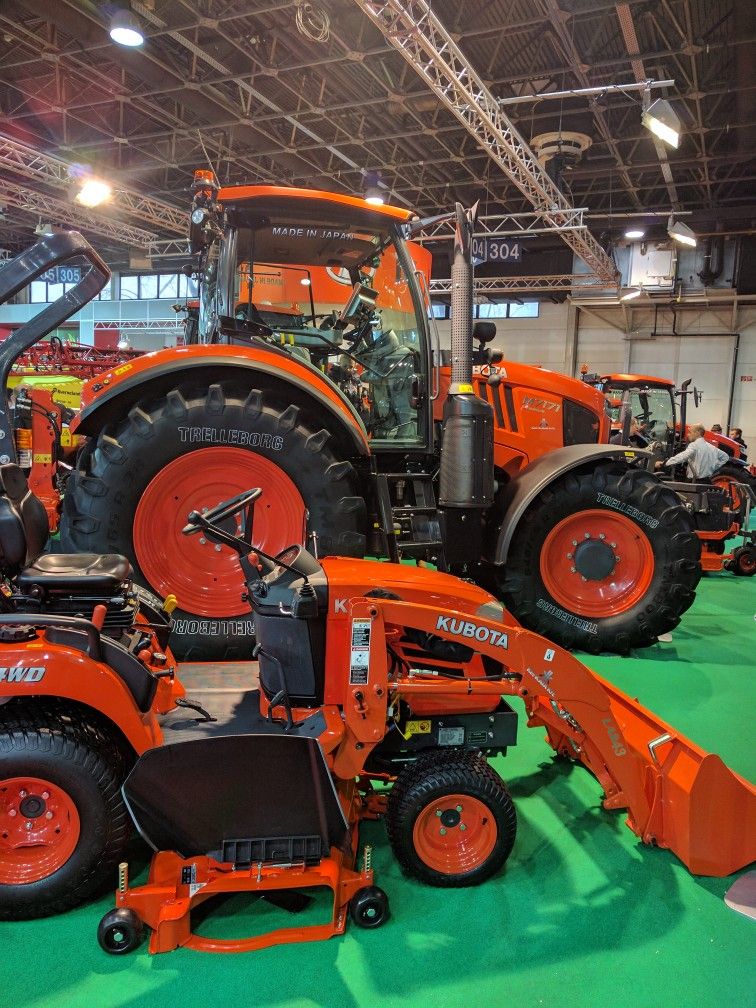
The financing partnership matters because it addresses Kubota's biggest historic obstacle in African markets: price. The company established a Kenyan subsidiary back in 2017 but has struggled to build meaningful market share, largely due to a higher price point than African farmers have often been able or willing to pay compared with lower-cost Indian and Chinese competitors. Backing from a major banking partner is intended to make Kubota equipment accessible through structured financing rather than requiring farmers to pay full price upfront.
Africa's tractor market is projected to reach $2.6 billion by 2030, driven by expanding large commercial farms and continued government support for mechanization programmes across multiple countries — growth Kubota is positioning itself to capture through both its own brand and Escorts, an Indian farm and commercial vehicle manufacturer it acquired that sells the Farmtrac and Powertrac brands widely across Nigeria, Angola, Burkina Faso, Egypt, and Tanzania.
Chinese Manufacturers Are Moving Fast Too
Kubota isn't the only international manufacturer racing to capture African demand. Chinese machinery maker Zoomlion unveiled its DV3504 hybrid tractor at NAMPO Harvest Day 2026 in Bothaville, South Africa's largest agricultural trade show, as the centrepiece of the company's expansion into the South African market. The tractor's hybrid electric drive system — built around Zoomlion's own MiDD distributed intelligent electric drive technology — adds short-term electric power support during peak-load field operations like deep tillage, which the company says can cut fuel consumption by roughly 20 to 30 percent compared with a conventional diesel tractor doing equivalent work, a meaningful saving for commercial operations running large fleets.
Chinese tractor brands more broadly have been making significant inroads across the continent, helped by competitive pricing, steadily improving technology, and expanding dealer networks. Availability has improved considerably in recent years, particularly in countries where manufacturers have established authorised dealerships and service centres capable of supporting machines after the sale — addressing one of the recurring criticisms of earlier mechanization pushes that dropped equipment into markets without adequate repair infrastructure behind it.
Sponsored
Kenya's Coastal Expansion
Further evidence of the sector's momentum came in Mombasa, where automotive and equipment distributor CFAO Kenya opened a new Case IH agricultural machinery showroom at Mnazi Mmoja earlier this year. The launch event drew executives from CNH Industrial, CFAO Kenya, and Mombasa County officials. Vincent DeLassange, Vice President of CNH Middle East and Africa, described Kenya as one of Africa's fastest-growing agricultural markets, while CFAO Group Chairman and Country Delegate Ambassador Dennis Awori said the new facility reflects confidence in both Kenya's agricultural potential and Mombasa's role as a regional trade hub.
Where the Growth Is Concentrated
Market data bears out Kenya's standout status: while Nigeria currently accounts for the largest share of Africa's tractor market — roughly 38.6 percent of 2025 sales, anchored by federally subsidised loan programmes — Kenya is forecast to post the fastest growth of any tracked country through 2031, driven partly by horticulture exporters standardising precision farming implements as they scale up for export markets. Medium commercial farms currently account for the largest single share of tractor demand, though contract-hire and rental fleets are forecast to grow fastest of all, reflecting a broader shift toward cooperative and pay-per-use machinery access rather than individual ownership — a model county-level cooperatives in both Kenya and Tanzania are already using to lower effective rental costs for smallholders.
Taken together, Kubota's financing push, Zoomlion's hybrid-tractor debut, and CFAO's new Mombasa showroom point to the same underlying trend: international equipment manufacturers are no longer treating Africa as a secondary export market, but as a genuine growth frontier worth building dedicated financing, dealer, and service infrastructure around.